Current Bay Research and Restoration in Richardson Bay
Eelgrass
- Work in collaboration with San Francisco State University continues looking at seeding and whole plant propagation techniques and if bat ray fences give the seeds a better chance of survival.
- Work funded by San Francisco Foundation in collaboration with San Francisco State University began in January 2007 to look at how water depth relates to eelgrass restoration success. This work includes:
- Planting eelgrass at four depths (+1, 0, -2 and -3 feet tidal heights)
- Planting seeds, seedlings and whole plants to see which has the highest success rate.
- Modeling bay circulation to look at potential seed dispersal

- Core samples will be taken to look at the differences between species diversity inside and outside eelgrass beds.
- Plans are in place to plant 500 adult shoots and 500 seeds between September 2007 October 2008.
- We are currently mapping the distribution of eelgrass within the Sanctuary using kayaks (rentals donated by Sea Trek) and GPS units.
 photos by Chris Ryan
Native Oyster Restoration [top]
- We are collaborating with SFSU, UC Davis, Smithsonian Environmental Research Institute, Save The Bay, NOAA, Kleinfelder, Marin Rod and Gun Club, and the Natural Heritage Institute to standardize our oyster research and begin a large-scale recruitment study throughout San Francisco Bay.
- We are conducting a field experiment in Richardson Bay looking at settlement and recruitment inside and outside eelgrass habitat and at two depths in the water column. We are placing surface and near benthos bags (10 oysters/bag) inside and outside eelgrass habitat and making monthly checks for settlement and recruitment.
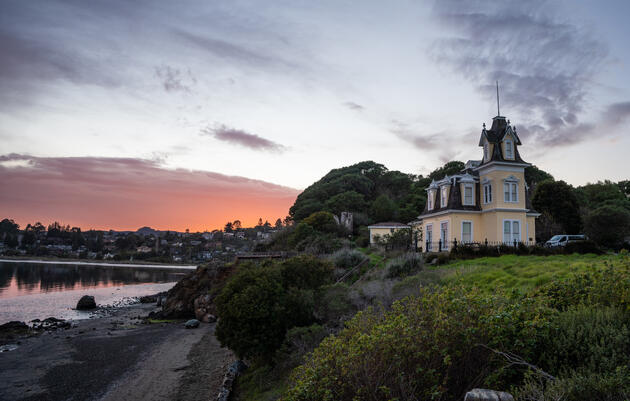
- We have begun setting-up and conducting long-term intertidal monitoring of oyster populations and habitat availability at the beach in front of the Lyford house and at Blackie’s pasture.
Fish Monitoring [top]
Our ongoing study will continue from 2006 using fish pots to look at fish species utilizing the eelgrass beds and restoration site. To date we have found 22 different species of fish species in Richardson Bay.
CabezonLeopard Shark

Bay Pipefish Black Surfperch
photos by W.Norden

As this graph indicates, we have captured more fish inside the eelgrass bed than outside.
Fish species found in Richardson Bay
- Bay pipefish Syngathus leptorhynchus
- Bat ray (seen only) Myliobatis californica
- Black Surfperch Embiotoca jacksoni
- Cabezon Scorpaenichthys marmoratus
- Chamelian goby Tridentiger trigonocephalus
- Cheekspot goby Ilypnus gilberti
- Crescent gunnel Pholis laeta
- Diamond turbot Hypsopsetta guttulata
- Dwarf surfperch Micrometrus minimus
- Jack smelt Trachurus symmetricus
- Leopard shark Triakis semifasciata
- Northern anchovy Engranlis mordax
- Pacific herring Clupea harengus
- Pacific staghorn sculpin Leptocottus armatus
- Pile Perch Damalichthys vacca
- Shiner surfperch Cymatogaster aggregata
- Starry flounder Platichthys stellatus
- Striped bass Marone saxatilis
- Striped seaperch Embiotoca lateralis
- Threespine stickleback Gasterostreus spp
Water Quality Monitoring [top]
The graph above shows how water temperature, salinity and dissolved oxygen change in the Bay over the course of a year.
Waterbirds [top]
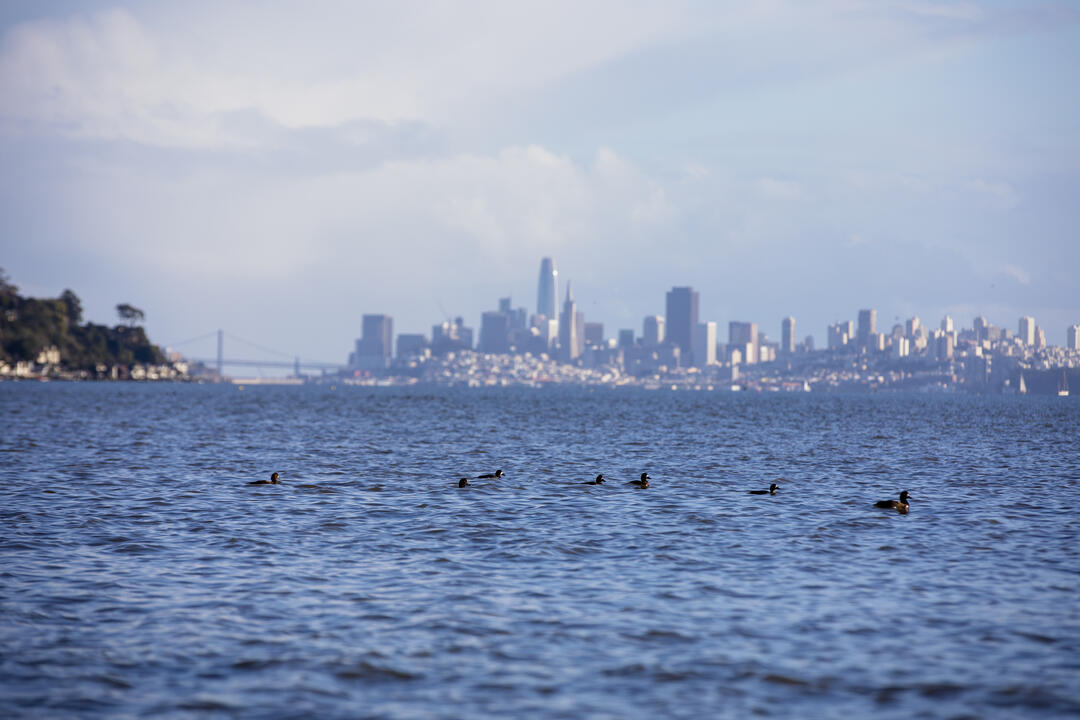
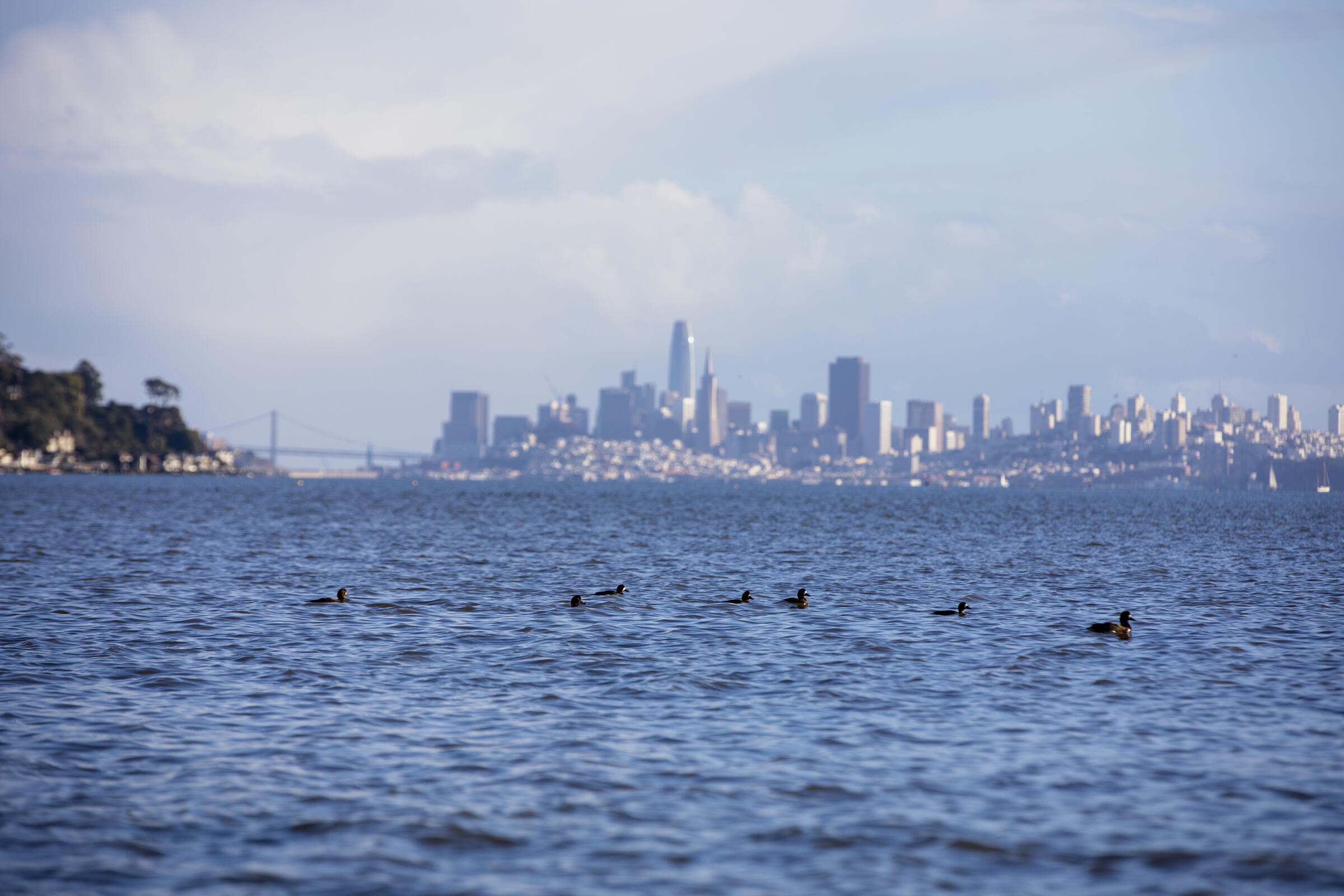
Hundreds of thousands of migratory waterbirds such as ducks, geese, grebes and shorebirds converge on the San Francisco Bay Area during the winter to take advantage of abundant food and shelter resources here. In Richardson Bay, nine hundred acres are closed to all boat traffic from October 1 to March 31 each winter in order to protect the birds that use the area; these submerged lands make up the Richardson Bay Audubon Sanctuary.
In order to better understand the current use of Richardson Bay by waterbird species, compile baseline data for future comparisons and to link analyses to concurrent research being done on eelgrass and oysters, regular surveys were initiated in the Fall of 2006. A separate protocol is being developed with staff from the USGS-BRD office in Vallejo for finer-scale analysis of the relationships between birds and the bay habitat.
Additionally, Audubon has contracted with PRBO Conservation Science to compile an historic bird use index of Richardson Bay, which will help us to understand long- term waterbird community changes resulting from restoration efforts and other factors.
RESULTS
Nine surveys were conducted from points around the Bay during the winter of 2006-07 with help from a group of dedicated local volunteers. An average of 3425 birds representing 46 species was counted each survey; the low count was 913 in October and the high count was 6870 in early February. The most common species seen were Western or Clark’s Grebes (genus Aechmophorus), Double-crested Cormorants, Buffleheads, Ruddy Ducks and Greater Scaup.

Double-crested Cormorants feeding on Richardson Bay. (K. Wilcox)

Bufflehead (L), and Greater Scaup. Ruddy Duck, male in breeding plumage.
Source: US Fish & Wildlife Service
The graph below shows some of the survey results over the course of the winter, with the highest number of birds seen between the months of December and February.

This page will be updated as further analyses provide us with greater insight into the dynamics of these populations and how they relate the Bay ecology as a whole.
2006-07 WATERBIRD SURVEY SUMMARY RESULTS
|